What if fixing a cavity didn’t involve the piercing whine of a mechanical drill or an injection that leaves your cheek numb for hours? If you’ve been searching for pain free laser cavity removal 95129, you’re likely wondering whether it’s truly possible to treat tooth decay without traditional dental drills, needles, and lingering anesthesia.
Most people dread routine fillings because of the sensory discomfort: the jarring vibration against enamel and the unnecessary loss of healthy tooth structure. Fortunately, modern hard-tissue dental lasers completely reshape that experience. By utilizing gentle light energy rather than mechanical friction, advanced lasers remove decay with microscopic precision while preserving as much natural tooth structure as possible. Because the process avoids heat and vibration, many patients comfortably receive treatment without needing local anesthetic injections.
This guide explores how drill-free laser restorations work, their clear benefits over conventional methods, and what to expect from a gentle, low-stress clinical visit in West San Jose.
Key Takeaways
- Explore how hard-tissue laser technology gently vaporizes tooth decay using concentrated light and water droplets, eliminating mechanical friction.
- Learn why seeking pain free laser cavity removal 95129 can help you avoid local anesthetic injections, dental drills, and prolonged facial numbness.
- Understand how microscopic precision preserves more healthy natural enamel compared to traditional high-speed mechanical burs.
- Find out which cavity types qualify for laser restorations and how Dr. Jianye Chen pairs advanced laser care with calming amenities like massage treatment chairs.
What Is Pain Free Laser Cavity Removal and How Does It Work?
Traditional dental restorations rely on mechanical friction to cut away decayed enamel, spinning a carbide or diamond bur at hundreds of thousands of revolutions per minute. Hard-tissue dental lasers replace this invasive grinding with concentrated photonic energy. By focusing precise light pulses directly onto compromised tooth structure, the laser vaporizes dental decay without direct physical contact. For patients seeking pain free laser cavity removal 95129, this biological approach transforms a once-stressful dental appointment into a quiet, gentle experience.
The Science of Hard-Tissue Dental Lasers
The clinical efficacy of drill-free cavity removal lies in how specific laser wavelengths interact with dental anatomy. Hard-tissue lasers, typically operating in the Erbium wavelength spectrum, emit light energy that is instantly absorbed by water molecules and hydroxyapatite crystals within the tooth. Because decayed enamel and dentin contain significantly higher concentrations of water than healthy tooth structure, the laser selectively targets the diseased area. The internal water molecules rapidly expand and micro-vaporize the damaged tissue.
Dental laser technology pairs these energizing pulses with a continuous, fine water mist that delivers two key clinical advantages:
- Thermal control: Continuous hydration neutralizes heat buildup, keeping the tooth cool and preventing irritation to the sensitive inner nerve pulp.
- Microscopic accuracy: The laser removes decay layer by layer in microns, preserving sound, healthy enamel that conventional rotary drills frequently cut away.
Why Most Patients Require No Needles or Numbness
Dental anxiety is often rooted in the discomfort of local anesthetic needles and the high-pitched whine of a mechanical drill. However, pain during conventional fillings is primarily triggered by two factors: friction-generated heat and the jarring vibration transferred through the jawbone to the pulp chamber.
Because hard-tissue lasers work without physical contact or thermal elevation, the tooth’s sensory nerve fibers remain calm and undisturbed throughout the process. In the vast majority of routine restorations, patients don’t require local anesthetic injections. You can bypass the sting of a syringe, relax through a quiet procedure, and return to work or family life immediately without hours of lingering numbness in your lips, tongue, or cheek.
Laser Cavity Prep vs. Traditional Dental Drilling: Clinical Comparison
Choosing between a mechanical drill and a restorative laser comes down to structural biology. While high-speed rotary handpieces have served dentistry reliably for decades, they rely on brute mechanical force. By contrast, pain free laser cavity removal 95129 introduces a conservative clinical standard that prioritizes long-term tooth preservation alongside immediate patient comfort.
Enamel Conservation and Structural Integrity
Rotary handpieces spin rigid burs that cut in broad, sweeping motions. To establish adequate mechanical retention for a traditional filling, dentists often have to remove peripheral healthy enamel alongside decayed tissue. This subtractive process weakens overall tooth structure.
Laser cavity preparation changes that dynamic completely:
- Targeted ablation: Light energy discriminates between infected and healthy tissue, preserving sound tooth boundaries.
- Zero mechanical torque: Rotary burs create micro-vibrations and chatter that can cause hairline enamel fractures. Over time, those micro-cracks allow bacteria to leak beneath restorations. Lasers eliminate that physical stress entirely.
- Maximum structural retention: Keeping more of your natural tooth intact significantly lowers the likelihood of needing inlays, onlays, or crowns down the road.
Sterilization and Long-Term Restoration Success
Beyond shaping the tooth, restorative lasers deliver distinct biochemical benefits that standard drills cannot replicate. As the laser pulse vaporizes diseased dentin, the thermal energy instantly cauterizes and sanitizes the immediate preparation site. It eradicates residual bacteria deep within microscopic dentinal tubules, dramatically reducing the risk of recurrent decay underneath the newly placed restoration.
The laser beam also modifies the tooth’s surface architecture. Instead of leaving behind a smeared layer of debris like a mechanical bur, it creates an etched, microporous surface. This clean, textured enamel bonds significantly tighter with modern tooth-colored composite resins, creating a superior marginal seal. For patients interested in comprehensive wellness, learning about laser dentistry San Jose provides deeper insight into how these modern protocols safeguard oral health.
If you’re weighing your restorative options, consulting with a skilled provider at butterflydental.net can help you decide whether gentle laser preparation is the right clinical approach for your smile.
Am I a Candidate for Drill-Free Laser Fillings in 95129?
Whether you’re managing intense dental phobia or simply want to protect your natural teeth, hard-tissue laser therapy offers a modern restorative pathway. Determining your candidacy begins with evaluating the location, stage, and type of decay present. Most patients seeking pain free laser cavity removal 95129 find that their routine restorative needs align perfectly with drill-free methods.
Best Clinical Applications for Dental Lasers
Hard-tissue lasers excel in specific anatomical areas where precision and conservative tooth preparation are essential:
- Class I restorations: Treating newly developed pit-and-fissure decay across the biting surfaces of molars and premolars. The laser accesses deep grooves without cutting into surrounding healthy enamel ridges.
- Class V restorations: Removing smooth-surface decay along the gumline. Because lasers operate with pinpoint accuracy, they clear the cavity without causing mechanical trauma or bleeding in adjacent gum tissue.
- Class II restorations: Clearing interproximal lesions between teeth when paired with modern matrix systems.
- Pediatric and anxious patients: Children and phobic adults thrive with this approach. Avoiding needles and mechanical vibrations prevents sensory triggers and builds clinical trust.
When Conventional Techniques May Still Be Needed
While laser technology represents an impressive advance in modern dentistry, it is not a universal replacement for all conventional dental instruments. Transparent clinical care means recognizing realistic boundaries where mechanical tools or specialized procedures remain necessary.
For example, dental lasers cannot safely ablate existing silver amalgam fillings. Directing laser wavelengths onto metal alloys can cause dangerous thermal transfer to the tooth nerve or release mercury vapor. Removing defective metal fillings still requires traditional high-speed instruments. Similarly, extensive crown preparations requiring bulk reduction of enamel rely on rotary burs for rapid shaping. In cases of severe infection where decay has penetrated deeply into the root canal system, you may require specialized interventions like those covered under urgent dental care San Jose rather than a conservative filling.
During your initial comprehensive examination, your dentist will capture high-resolution digital imaging to confirm whether your specific cavity qualifies for an all-laser approach.

What to Expect During Your Laser Cavity Removal Appointment
Walking into a dental operatory often triggers tension, especially when anticipating the sounds and sensations of traditional restorative tools. Knowing exactly what happens at each stage demystifies the procedure and puts your mind at ease. When opting for pain free laser cavity removal 95129, the entire appointment follows a gentle, streamlined protocol designed around patient comfort.
Step-by-Step Treatment Protocol
The appointment unfolds in four transparent stages:
- Diagnostic evaluation: High-resolution digital imaging pinpoints the exact depth and perimeter of the decay, confirming that a hard-tissue laser is the best approach.
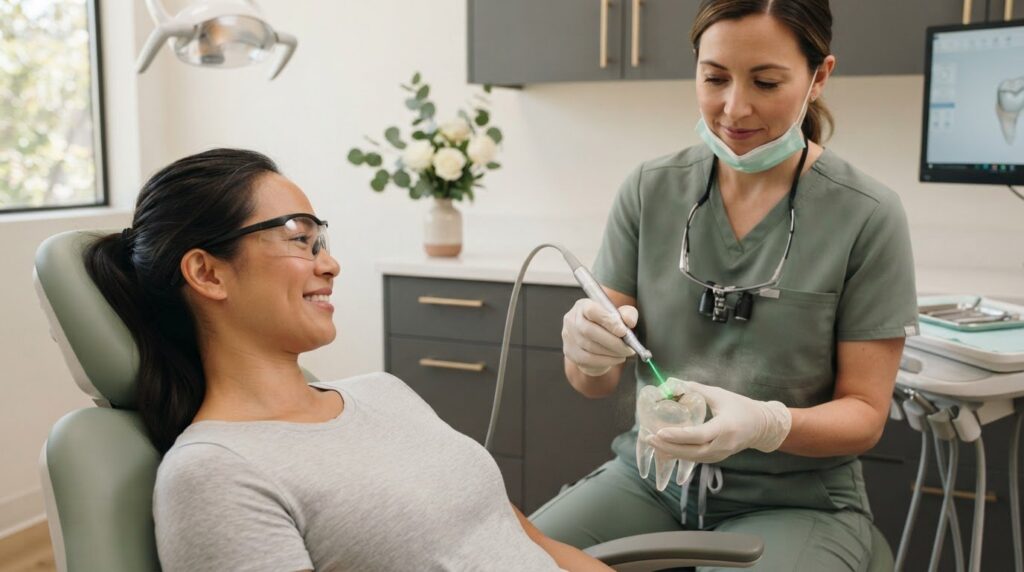
- Protective eye safety: Before clinical work begins, you and the clinical team put on specialized tinted glasses. These filter out specific laser wavelengths, ensuring complete ocular protection throughout the visit.
- Photonic decay ablation: The dentist directs the laser handpiece toward the tooth. Focused pulses vaporize the compromised enamel while a soft water mist maintains constant cooling.
- Direct composite restoration: With the cavity fully cleared and sterilized, the dentist applies a tooth-colored composite resin, shapes it to match your natural bite, and cures it with a specialized blue light.
The Sensory Experience: No Whining Drills, No Numb Lips
What surprises most patients is how tranquil the room feels compared to conventional filling appointments. The high-pitched mechanical whine of a dental drill is entirely absent. In its place, the laser emits a light, rhythmic popping or clicking sound, often compared to the gentle sound of popcorn popping in the distance.
Physically, you don’t feel friction, heavy pressure, or vibration radiating through your jaw. The continuous water spray delivers a refreshing, cool sensation around the treated tooth. Best of all, because local anesthetic injections are generally unnecessary for standard preparations, you avoid the sting of a syringe. You won’t face three to four hours of droopy lips, slurred speech, or accidental cheek-biting. When the filling is polished, you can immediately speak clearly, drink water, and eat a meal without waiting for a nerve block to wear off.
Ready to experience a modern, drill-free approach to restorative care? You can schedule your visit with Butterfly Dental Care to enjoy comfortable, needle-free fillings tailored to your smile.
Gentle Laser Cavity Care at Butterfly Dental Care in 95129
Finding a clinical provider who pairs cutting-edge equipment with genuine human warmth can transform how you perceive dental appointments. At Butterfly Dental Care, restorative treatment is designed around peace of mind and personal comfort. For residents seeking pain free laser cavity removal 95129, this modern private practice delivers conservative, drill-free care tailored to protect your smile’s long-term health in a relaxing setting.
The Compassionate Approach of Dr. Jianye Chen
Under the clinical direction of Dr. Jianye Chen, Butterfly Dental Care approaches restorative dentistry with a conservative, tissue-preserving philosophy. Dr. Chen recognizes that clinical skill must be matched by an attentive bedside manner, especially when working with patients who carry deep-seated dental fears.
Every restorative plan begins with transparent, unhurried communication. Dr. Chen takes the time to explain your diagnostic findings clearly, showing you exactly where decay has formed and outlining how laser energy can safely resolve it. Rather than applying a one-size-fits-all protocol, treatment is customized to your unique dental anatomy, bite dynamics, and personal comfort level. By utilizing advanced laser dental treatments, Dr. Chen prioritizes natural tooth conservation at every stage.
Modern Comforts Designed for Dental Anxiety Relief
A calming clinical experience involves far more than modern instruments; it requires an environment where you feel fully supported. Butterfly Dental Care thoughtfully addresses sensory comfort from the moment you step through the door.
The practice features calming amenities specifically selected to ease clinical tension:
- Ergonomic massage dental chairs: Gentle, integrated massage settings help relax tense muscles and quiet the nervous system while your tooth is being treated.
- A soothing, quiet clinical atmosphere: The absence of high-speed drill sounds, combined with a peaceful treatment room design, eliminates the typical sensory triggers of a traditional dental visit.
- Convenient neighborhood access: Centrally located to serve patients across West San Jose, Cupertino, and the greater 95129 community.
If you have delayed treating tooth decay due to fear of injections, drill vibrations, or lingering facial numbness, conservative laser care provides a welcome alternative. Dr. Chen and the team at Butterfly Dental Care are ready to help you restore your oral health with the gentleness, precision, and respect you deserve.
Reclaim Your Peace of Mind With Modern Cavity Care
Treating tooth decay no longer requires enduring painful injections, jarring vibrations, or hours of post-treatment numbness. By harnessing concentrated light and a cooling water mist, hard-tissue lasers protect healthy enamel while preserving the natural strength of your smile. Opting for pain free laser cavity removal 95129 allows you to step away from clinical anxiety and embrace a gentle, conservative standard of restorative wellness.
At Butterfly Dental Care, Dr. Jianye Chen pairs advanced restorative dental lasers with thoughtful amenities, including soothing massage dental chairs, to ensure your visit is restful from start to finish. You don’t have to delay essential dental care because of past experiences with the drill. Schedule your comfortable laser cavity consultation with Dr. Chen today, and discover how relaxing protecting your oral health can truly be.
Frequently Asked Questions
Is laser cavity removal completely pain free?
Yes, the vast majority of patients report no pain during the procedure. Because laser pulses don’t generate friction, pressure, or thermal elevation within the pulp, sensory nerve fibers remain largely undisturbed. Most people receive pain free laser cavity removal 95129 without requiring local anesthetic injections or needles. At most, you might feel a mild cooling sensation from the continuous water mist that keeps the enamel hydrated.
Can lasers be used for all types of tooth decay?
No, lasers cannot treat every presentation of tooth decay. Hard-tissue lasers excel at treating new pit-and-fissure decay on chewing surfaces, smooth-surface cavities along the gumline, and moderate interproximal lesions. However, they cannot safely ablate existing metal amalgam fillings or shape teeth for full crowns. In cases involving deep pulp infections or severe structural breakdown, conventional dental instruments or specialized restorative procedures remain clinically necessary.
How much tooth structure is preserved compared to traditional drilling?
Lasers preserve significantly more natural tooth structure than mechanical drills. High-speed burs rotate broadly, often requiring the removal of healthy enamel to form a mechanical retention box. Lasers work with microscopic precision, selectively vaporizing only the decayed, water-rich dentin while leaving sound boundaries intact. This conservative preparation maintains the tooth’s structural integrity, reducing the long-term risk of stress fractures and complex future restorations.
What happens if my cavity is located beneath an existing filling?
If recurrent decay forms beneath an existing composite resin, a laser can often assist once access is established. If the restoration is silver amalgam, however, the laser cannot safely treat it because metal reflects and absorbs light wavelengths unpredictably. Your dentist will carefully remove the old filling with conventional rotary instruments before using the laser to gently clear remaining bacteria and prepare the site for a fresh, tooth-colored restoration.
Is laser dentistry safe for children and pregnant patients?
Yes, laser dentistry is exceptionally safe for both pediatric and pregnant patients. Hard-tissue lasers use non-ionizing, focused light that does not emit radiation or harm biological tissue. For expectant mothers and young children, the ability to complete fillings without injected chemical anesthetics significantly reduces systemic stress and appointment anxiety. Everyone in the operatory simply wears protective wavelength-filtering eyewear during the brief procedure to ensure total ocular safety.
Can I eat immediately after having a laser cavity filling?
Yes, you can typically eat and drink immediately after your appointment. Because modern composite resins are fully light-cured before you leave the chair, the restoration is instantly hardened. More importantly, since pain free laser cavity removal 95129 usually eliminates the need for numbing injections, you won’t experience lingering lip or cheek anesthesia. You can chew comfortably right away without the risk of accidentally biting your tongue or cheek.
Does dental insurance cover laser cavity removal in San Jose?
Most dental insurance plans cover the cavity restoration itself, regardless of whether a laser or mechanical drill is utilized. Insurance providers generally reimburse based on standard procedure codes for composite fillings and the number of treated tooth surfaces. While coverage specifics vary between insurance policies, practices do not typically charge separate surgical fees for using laser technology. It is always best to have your dental team verify your plan’s benefits prior to care.
 English
 Chinese (Simplified)
 Spanish
 Vietnamese